Sunday, 25 August 2019

Emiel Rommelaere 1873-1961


 My terrace when empty; not sure that guests want
their images plastered over my blog!!
The recent MA Festival in early August, as usual brought a number of friends to Brugge, two to stay with me and the rest scattered around the Egg. I used to put on a lunch for ‘the boys’ as I call them, despite there being one or two girls among them! But as the energy edges down, I resorted first to brunch for three years and then, this August, to a tea party on the terrace. It was a lovely sunlit scene with everyone managing to find a space among the plants and little trees claiming first place. I was doing relatively little except a spot of ‘gracious hostessing’ when Joachim, a long-term friend met through my husband Eric almost certainly on my first visit to the Festival [then the Festival Van Vlaanderen] in 1989, suddenly emerged with a giant parcel festooned with curly ribbons. A birthday present no less, and totally unexpected, from five of those present. Joachim said that I had remarked a year before, when looking through a book on Bruges artists, “Oh I would love a Rommelaere!” I didn’t remember at all until I eventually located the book and a full page painting by Rommelaere and the memory returned, heavily visual, as usual!

 Stedlijke Brugse Academie
Rommelaere is 2nd on left, front row.
The painting was unwrapped to my delight and much admired by all and days later, hung at last by the chief conspirator and his husband. It is quite dark but SO redolent of the area leading up to the doors of the Beguinage and I love it and what it represents. I have found a mere skeleton of facts about Emiel online though there are five pages on him in my Dutch book on 19th and 20th century painters of the Bruges School. Emiel [always known by the Flemish version of his name] was born on March 27 1873, son of a policeman. He showed early artistic promise and in 1884 was enrolled at the Brugse Academie where he became a pupil of Louis De la Censerie, a famous name still in Brugge. During his student period he met and did work for, Corneille Leegenhoek, a local restaurateur whose daughter, Gabrielle, he eventually married on 27 April, 1897. Before his marriage, in 1891 he attended the Academie voor Schone Kunsten in Antwerp and eventually moved on to the Hoger [Higher] Instituut voor Schone Kunsten where he became a pupil and friend of Albert de Vriendt. He was much influenced by the style of de Vriendt and by 1895 he had accepted a Professorship at the Brugse Academie and resolved to return permanently to life in Brugge. He was both a painter in oils and a water colourist.
 A View on The Predikherenrei by Rommelaere

Rommelaere painted picturesque local scenes many times and still lifes while his landscapes in particular were influenced by the Impressionists. He worked with de Vriendt and painted a portrait of the Baron de Bethune in the Gothic Hall in the Stadhuis in his youth and there is at least one painting of his, Achterbuurt in Brugge 1925 in the Groeningemuseum. One notable painting, Grandmother’s Feast, earned a Gold Medal for him in a 1904 exhibition in Saint Louis in the United States. He participated in many exhibitions in the U.S., Mexico, London, Amsterdam, Cologne, Metz and Paris during his life. In 1908 he purchased a big house on Beenhouwersstraat where he installed a large atelier to provide ample room for both him and his daughter, Dora, also a skilled draughtswoman, to work. He spent many happy and productive years in this atelier until ill health forced his retirement at 77 [1950] when he went to live in Westkapelle.
 Louis De La Censerie 1838-1909

 A Bruges Mill


Saturday, 17 August 2019

The Disturbers of Our Harmony ***

The message is still the same though a little stronger.

Names not needed.
In spite of the embarrassment of having Boris-on-Speed leading the U.K. Government, and with an Excessively Positive, not to say Reckless Can-Do Outlook, [untethered to reality, as I read in the New Statesman] I am nonetheless unable to resist an anti-Trump rant. Each successive tweet from, or microphone opportunity for, the Keep America White Man-in-the-White-House, is SO disturbing and increasingly frightening, that silence is near impossible.

This outburst has been triggered by my hearing part of an Anthony Scaramucci interview on
Anthony Scaramucci.
BBC Radio 4 just now. Scaramucci was appointed as Communications Director by Trump in his first year, and lasted in the job about two weeks. For the following two years or so, unemployed by Donald but vilified by him, he continued to praise and defend his President. But suddenly, now, the scales seem to have fallen from his eyes as he has acknowledged that the real working class, Trump’s main power base, is not being respected or served well by him. Scaramucci is a Harvard-educated lawyer who has built up two businesses, the typical American dream for a boy born into a poor working class family. He represents some of the best of American achievements and the possibilities it has always, hitherto, afforded its incomers, immigrants and its poor.
 Republican Congressman Elijah Cummings

Trump’s white nationalist rhetoric is distasteful: “good people on both sides”, of the Charlottesville riots; the four young women Democratic lawmakers should ‘go back to help fix the totally broken and crime-infested places from which they came” [the eternal racist shout]; the Baltimore onslaught, and attack on Republican Congressman Elijah Cummings; and now the re-tweet suggesting that Bill Clinton was involved in the murder of Jeffrey Epstein. [AND, astonishingly, the quick White House defence of Trump’s defamatory re-tweet]. His earlier rants about Obama’s birth certificate; his unfounded allegation that millions of illegal votes were cast for Hilary Clinton; his constant refrain that Mexicans were invading America and were murderers and rapists [and his consequent imprisoning of unaccompanied children at the border]; his strong assertion that Russia didn’t interfere in the 2017 Presidential election [despite ample proof that it did, obtained by U.S. Intelligence] …. all seem to be a foundation for his increasingly paranoid remarks. But paranoia is being turned into policy according to CNN!
 Trump campaign trail crowd.

 In the 2016 election, 53% of white women
voted for Trump.
What does seem amazing and unbelievable is that he has a 44% approval rating and this has not slipped at all over his presidency. His support is, in the main, from far right and right-leaning white nationalists,
evangelists, racists and the working class, or the non-college-educated, as the Americans describe them. But what I find impossible to believe is that these large groups don’t mind, are willing to tolerate, or don’t notice, his painful degradation of American public life, the gradual shift in public discourse from caring and sharing, to excluding and denigrating. Do they not notice the ridicule, distrust and dismissal routinely directed now at America from
 Bewildered, lone toddler at Mexican/U.S.
border.
and in, the rest of the world? And our amazement should also be directed at the Republican Party; at how very little criticism of Trump has been voiced by Republican Senators and Congressional representatives as they have fallen into line. The silence over his various embarrassing and destructive racist pronouncements, attempted unsuitable State appointments and abortive efforts at changes in the law designed to complicate and hurt millions of small lives, has been deafening. His pugnacious relationship now with China which is inexorably developing into a trade war, will hurt American businesses in agriculture in particular, and increase the cost of living, potentially for millions who can least afford it.

But Trump didn't cause the bitter split in America between two huge groups though he has grossly exaggerated it; the far right is similarly, though less successfully active and popular in many countries; France, Spain, Italy, Hungary, Brazil, India, U.K. I read an interesting slant in The Times in July which suggested some critics saw Trump as a semi-literate halfwit totally lacking a reasonably sophisticated cognitive capability. Others had a darker view; they saw him as inarticulate, yes, but also as a manipulative and cynical demagogue, ... callously exploiting his supporters' ignorance to foster racial animus, intolerance and bigotry to further an autocratic right-wing agenda."  The title of the opinion piece [The Times. July 20 2019] is "Trump is riding a powerful wave of white resentment" but the article suggests that while white resentment has long been a vote-winner in America, outright appeals to, and encouragement of, overt racism have been relatively rare. 


The Pew Research Centre this year found support for Trump
at 69% among white evangelical Christians.


*** The Disturbers of Our Harmony.[Title]

From the original draft by Thomas Jefferson of the Declaration of Independence. The expression is contained in the section detailing the long list of King George's faults in his appalling treatment of Britain's largest colony, America, but the expression refers generally to the British. It seems now an apt but restrained epithet to describe the Trump Effect.
Signing of The Declaration of Independence 1776
Painted by John Trumbull 1819

Authored by many, over a period of months, the actual
Declaration of Independence was more of a final draft.


Sunday, 11 August 2019

Making Your Mark


 There has been a plethora of “cultural summer happenings” in Brugge this yeat. There is so much
 Feest in 't Park 2019
going on with a stream of free outdoor concerts like those during Moods; the trippeldagen of concerts to mark National Day on July 21 in the Burg; Feest in ‘t Park in Minnewater; Klinkende in different pubs; Cactusfestival again in Minnewater. And now the MA Festival [Musica Antiqua] is drawing to a close after many [not free] concerts in the Concertgebouw and churches, plus a Fringe to give
 Benenwerk 2019
opportunities to young musicians, and an International Competition featuring a three year cycle of organ; vocal and baroque ensembles; and harpsichord and other historical keyboard instruments. Did I remember to mention Dancing in the Vismarkt on Saturdays and Sundays? And the series of Carillon concerts throughout the summer months on Monday and Wednesday evenings. And of course, tomorrow, August 10th, there is Benenwerk, with different styles of dancing available at no cost, at different locations in the Egg, all free I believe

when Brugge will be even more full of visitors than usual!. These musical events, catering to a range of tastes, add a carapace of light-hearted spontaneity to the atmosphere here, mingling, as they do, in harmony with the church and convent bells and the usual carillon overtures, alongside the wonderful punctuation of horses’ hooves on cobbles. All while I try to ignore the  ten year low for sterling in exchange with the euro!

 Africa/Asia Reading Room, British Library
I recently received a welcome email from an American friend briefly describing a marvellous exhibition at the British Library entitled Writing: Making Your Mark. So enthused was I that I have delved into the British Library website to discover more and found what sounds to be treasure.

Babylonian stela from Mesopotamia, Iraq
Marduk Temple, 900-800 BCE.
Michael Erdman, one of the show’s curators, explains that the Library, in the age of the Internet when people might think that writing is becoming unnecessary, wanted to introduce to people what writing can be, can involve. He defines writing as any graphical representation of speech and the exhibition begins with the origins of writing [one of mankind’s greatest achievements] in Mesopotamia, Egypt, China, and the Americas and then traces the evolution of writing through technology and innovation with examples from over 30 different writing systems including Greek, Chinese and Arabic. Earliest items include a Mayan limestone stela from 647 A.D. Mayan writing
consisted of logograms [signs representing whole words; for example, a jaguar’s head signifying a jaguar] and syllabograms, [signs representing syllables; ka +ka +u =cacao] A later example is intriguing; from a wealthy but illiterate landowner from Ravenna, who used a symbol similar to a star inside a large wheel to sign a nine foot long papyrus deed for property/land sale and purchase.
 Caxton and his first book printed in England,
The Canterbury Tales.
Caxton lived for many years in the Woensdagmarkt/
Spiegelrei area here in Brugge.

Highlights of the exhibition include Scott of the Antarctic’s final diary entry; an 1800 year old wax tablet containing a schoolchild’s homework as he struggles to learn his Greek letters; Caxton’s first book printed in England, The Canterbury Tales; and a 60,000 strong petition from 1905 protesting against the first partition of Bengal and signed in both Bengali and English. And there is more! Mozart’s hand-written catalogue of his complete musical works from 1784-1791 featuring musical notation also. Plus Alexander Fleming’s notebook recording his discovery of penicillin from 1928.

Last entry, Scott's diary found after his
death, 1912.


For anyone reading this and living within reach of the British Library, the advice is to seek out this exhibition before August 26th!

Meanwhile, I love the words of Adrian Edwards, lead curator of the exhibition:


From hieroglyph to emoji and clay tablet to digital, Writing: Making Your Mark will demonstrate how writing is so much more than words on the page – it is how we communicate across time and space, how we express ourselves, and how we lay down our collective memory. We hope that visitors will consider their own relationship with writing in the digital age and reflect on whether we will abandon pens and keyboards in favour of voice-activated machine writing and video messaging, or continue to carry the legacy of ancient times with us.


 Last entries in Mozart's hand-written catalogue of his complete works
showing The Magic Flute and La Clemenza di Tito.
Begun Feb 9, 1784; completed at Mozart's death in 1791.
͖😀😀😀😀😀😀

Monday, 29 July 2019

Reflections on a theme


THINK this was at 83; obviously much younger!
Unbelievable that birthday 85 is close at hand. Unbelievable on several levels but chiefly because of the speed between numbers 84 and 85; the unseemly way Time speeds up inexorably as one grows older, is one of the manifestly unfair characteristics of ageing! And not the only one, it must be said.. The year by year visible slowing down, and the shrinking stamina also feature on the radar. The collapse of face and figure are so typical, so predictable, as to be barely worth mentioning! But the mental gaps present occasional nightmares though organisation here can help; a diary/ agenda and notes to oneself have important, face-saving functions. But the fact that one’s friends and relations die too soon cannot be denied or assuaged; this indeed is a common but inevitable and rather lonely feature of growing old, to be met with the stoicism developed in losing many battles over the years. One remembers, at funerals, that growing old is a privilege denied to many.

 My sister and I playing Mah Jong on the terrace
on our birthday last year.
But ageing isn’t all negative; not at all. One of the pleasures of growing old, unknown to the young, is giving things up. I have relinquished cooking for others [and do as little as possible for myself]; housework; sewing buttons on; pretending to like cakes and biscuits offered by lovely people [I simply refuse anything to eat which I don’t like]. And then there is the glorious freedom to decline to join activities which social obligation might well have demanded in the past. Among various seductive possibilities open to the Seriously Old, there is the total delight of saying exactly what one thinks, albeit politely, about almost everything; the determination which leads to effective action to avoid bores and boring situations even when social duty might demand otherwise; the utter delight of doing what one will, especially if, as I do, one lives alone unfettered even by the tiniest expectations of a partner. An octogenarian knows herself through long acquaintance; I know that I like to be liked but also that I do not need approval. The only imperatives come now from myself normally. There can be family requests, suggestions, questions but the deference due to age as seen by kind and considerate family members, keep these infrequent. After all, children and adult grandchildren have better things to do than pander unnecessarily to the egos of grandparents!! We are not needed very much and once accommodation to that fact has been made, it is a deliciously carefree place in which to be!
 Reflections in Brugge


I moved to live alone in Brugge at 80 on what can only be termed, ‘a whim’. I didn’t think too deeply about it but just did it, excited by the idea and trusting as ever in my ability to make everything turn out pretty well. Four and a half years later, I find myself living a happy life, a little life in the scheme of things, but satisfying and serene. In many ways it is a self-indulgent life but I tolerate that, as I tolerate my character flaws, with an amused acceptance!! It wasn’t always so and now is the time to do the things I love. I love reading, urban walking, going out to lunch, attending the occasional concert, meeting friends. Especially, I love socialising while also loving being alone; a perfect combination for one soul. Perhaps my favourite pastime has become Mah Jong, unknown to me until three years ago but now played every week with up to seven friends. We are all dotty about it and discover inventive ways to add the occasional celebration to our sessions. This week, champagne for my impending birthday; next week, Chinese food, courtesy of our teacher and leader, Nancy, for my birthday just gone! If one can cook up old age with self-indulgence sprinkled on top, that is delicious!


My other weekly favourite activity is my Thursday group; begun for locals, already good to fluent in English but wanting regular practice. Members of that group have become dear friends who meet for a drink and a chat; there is the occasional tea party and this week, a wonderful outing to a Portuguese restaurant for a birthday meal for me. Really, when I consider all, my cup runneth over.


I noted down recently a quote from Confucius which greatly entertained:
Chinese philosopher, Confucius 551-479 B.C.

Old age, believe me, is a good and pleasant thing. It is true you are gently shouldered off the stage but then you are given such a comfortable front stall as spectator.

I remembered that last week as my daughter in California Facetimed me [oh yes, family Facetime is another Good Thing] to tell me of all the turbulence in her little family’s life at present; all good possibilities but all the balls in the air too!! But they are confident jugglers and I watch from afar and admire; it is just marvellous to be a loving spectator and not an actor!


 Always time for beautiful reflections in Brugge!

Sunday, 21 July 2019

The Book of Kells


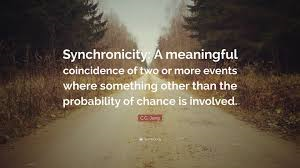
Carl Jung, analytical psychologist, coined the name, ‘synchronicity’ in which he posited an
underlying pattern beneath everyday actions which accounts for unexpected, unpredictable
events. In other words, meaningful coincidences occurring with no apparent causal relationship yet seeming to be significantly related. He introduced the concept in the 1920s but did not further define it until 1951 in a public lecture when he used the word in arguing for the paranormal. He suggested that events could be connected by causality but also might be connected by meaning.

 Three of the ten major full-page illustrations, showing
St Matthew, St. John and Virgin & Child with angels.
Synchronicity may be too grand and sweeping a term but it immediately came to mind when a friend recently gave me an illustrated introduction to the Book of Kells by Bernard Meehan together with a small companion guide to the imagery, history and symbolism of the Book of Kells by Ben Mackworth-Praed. Immediately, back came a very strong memory of the admiration, even envy, that I had felt in the 1970s when a colleague told me that he and his wife had just ordered a copy of the about-to-be-published, full colour facsimile of the Book of Kells. I now see that the art publishers, Thames and Hudson, under licence from the Board of Trinity College, Dublin, published a facsimile edition in full colour in 1974. I cannot remember the cost but at the time, it was so huge to me in 1974 [with three children aged between 10 and 12 to provide for] as to be totally unattainable! The lucky collector eventually brought in his newly-acquired pride and joy to show to me. It was indeed, a delight to see, unattainable but powerfully beautiful.

 Ruins of the Abbey of Kells


For the uninitiated, the Book of Kells is an illuminated manuscript in Latin of the four Gospels of the New Testament together with prefatory texts and tables. It is a work of outstanding beauty, created by Celtic monks around 800 A.D. in a Columban monastery in either Iona or Kells and housed for centuries in the Abbey of Kells. The Abbey of Kells in County Meath, Ireland, was re-founded by the monks from Iona on the Isle of Mull, off the coast of Scotland, and built between 807 and 814, the relocation coming as a result of devastating Viking raids which began on Iona in 794.These brutal raids dispersed the monks and their holy relics further afield into Scotland and Ireland. However, Kells, too, in its turn, was repeatedly raided by the Vikings during the 10th century.

The illustrations and ornamentation in the Book of Kells, are stunning, combining traditional Christian iconography with the swirling, ornate motifs typical of British art, known as Insular Art. There are ten full-page illustrations, and many text sheets featuring decorated initials and interlinear miniatures with
Detail of lion head decoration
 Peacock, above
Dove, below
figures of humans, animals and mythical beasts plus Celtic knots, all adorning the 340 calf vellum folios. [folios are separate sheets, written on one side only] The exceptional quality of the art attests to the fact that at the period of the production of the Book of Kells, the monastic community responsible for it, must have been rich and stable with an established library and a large number of scribes and artists. Furthermore, that community included several monk-artists of conspicuous, indeed, superlative, talent, in itself, an act of synchronicity!

Three artists seem to have produced the major decorated pages. One monk was capable of such fine and delicate ornamentation that his sophisticated skills have been compared to those of a goldsmith. Four major scribes copied the text, each with his own individual style and characteristics, but all working within the traditions of what was known as the scriptorium style. One scribe, for instance, was in the habit of leaving the decoration of letters at the beginning of verses to an artist while perhaps the last scribe to join the enterprise is probably responsible for the bright colours, purple, red and yellow, used on some folios and is also the one with the habit of filling spaces with unnecessary repetition of certain passages. It has not been determined if artist and scribe, in some cases, might have been the same monk.

Chequered History.

The Annals of Ulster, describing the Book of Kells as ‘the chief treasure of the Western world’, record that it was stolen from the western sacristy of the great stone Abbey at Kells, in 1006 by raiding Vikings, chiefly for the extravagant ornamentation and wealth of its enclosing shrine. The Book was eventually discovered, 'after two months and twenty nights' without the shrine and with several pages at the beginning and end ripped out when the valuable shrine was hurriedly torn off, and the Book thrown ‘under a sod’. When rescued, it remained at Kells throughout the Middle Ages, venerated as the great gospel book of St Colum Cille. In the late 11th
 Book of Kells, facsimile edition
and 12th centuries, following contemporary, monastic custom, blank pages and spaces were used to record property transactions relating to the monastery at Kells. In 1090, it was reported that relics of Colum Cille, [St Columba and founder of Iona in 561 and the Saint to whom the Book of Kells was probably dedicated] including ‘the two gospels’ had been brought to Kells from Donegal. The two gospels were probably the Book of Kells and the Book of Durrow. The Book of Kells was always referred to as 'the great gospel book of Colum Cille 'throughout the Middle Ages.

After the Cromwellian rebellion of 1641 when the abbey at Kells lay in ruins, fit only for stabling, around 1653, the Book of Kells was sent for safety to Dublin by the Governor of Kells, the Earl of Cavan. Eventually, in 1661, when Henry Jones, Vice Chancellor of the University of Dublin became Bishop of Meath, he had the Book transferred to Trinity College where it has been on permanent public display since the mid 19th century. It was from this period that the Book of Kells gradually assumed the role of art object. Two of the four volumes are always exhibited, one showing a page of a major illustration and the other a typical text page. It currently attracts over 500,000 visitors each year.

 The famous Chi-Ro page introducing
St Matthew's account of the Nativity.

Cloisters at Iona.
Iona is a small island, only 5.5 x 2.5 km at its greatest. Large enough
to support a big monastery, nonetheless, its size and position left it vulnerable
to Norse attacks. One raid, in 806, left 66 dead and triggered the
first moves of survivors to Kells in 807.

Sunday, 14 July 2019

Haiku revisited


I was recently in de Reyghere, the bookshop in the Markt, when my eye was caught by a slim The Narrow Road to the North and Other Travel Sketches, containing some of the writings of Matsuo Basho, a Japanese poet and diarist born near Kyoto in Japan in 1644. Reputedly the son of a samurai and confirmed as a scholar, he became both a wanderer and a teacher as well as a writer. He shared his reflections and truths obtained through meditation on his long walks. In his writing he was strongly influenced by the Zen sect of Buddhism. I think the book [published in 1966] was in a Reduced display which is probably why it caught my eye, but when I eventually opened it to read, I was charmed to discover that the Introduction by Nobuyuki Yuasa was entirely on Haiku, tracing an accessible history of its development and its form as well as telling the story of Matsuo himself. Matsuo Basho was one of the most famed traditional Japanese poets, one of a group known as The Great Four and their work remains as a model for today’s budding Haiku poets. Basho himself is still revered for his wisdom and for his writing.

A particular word can have a similar effect on the consciousness to a fragrance in its potency to trigger recall. I hadn’t thought of Haiku for years but memories flooded back of my using Haiku in the English language classroom to interest, even inspire, reluctant teenage poets!! But first, a word or two about Haiku.

What is a haiku? It is a three line, beautifully descriptive form of Japanese poetry, intended to be read in one breath. It does not rhyme but traditionally has five syllables in line one; seven syllables in line two and five in line three; punctuation and the use of capital letters is left to the writer. It can include repetition of words or sounds but it tries to feature an emotional or intuitive leap on the second and third lines where there may be a gap; something deliberately left out. The last line is often used to make an observation on the first two lines. Often, haiku subjects are based on a celebration of Nature or perhaps abstract subjects like happiness, although Basho insisted that the emotion of a haiku was not written but was only the emotion aroused in the reader. Modern haiku focus on simple yet sensory language, trying to create a brief moment in time and a sense of illumination, the structures can be looser and traditional rules ignored.
 Matsuo Basho
by Yosa Buson
1716-1764

This sounds complicated and though examples appear simple, Haiku IS more complex. My pupils enjoyed the basics simply because they could count syllables and it was, mostly, for them, the ingenious finding and grouping of words/syllables to fit the subject and the 5-7-5 structure, crucially [for them] without rhyme. In the hands of a Master, of course, it is much more. Interestingly in the little Basho book, many, many of the examples do not fit the exact traditional structure; many are of four lines length but this may well be because of the translation from Japanese to English. The actual word, Haiku, for instance, has two syllables in English but three in Japanese!

Two examples of Basho’s most famous poems are the ' silent pond' above and:


On a withered branch
A crow has alighted
Nightfall in Autumn.


 An early twentieth century haiku by Japanese 
poet, Natsume Soseki

Over the wintry forest
winds howl in rage
with no leaves to blow.

A modern Western haiku from The New Haiku edited by John Barlow and Martin Lewis:

empty cafe
he hangs a spoon
on the waitress’s nose. (Sounds as if they are getting friendly! AND no 5-7-5 here.)


And one of my inexpert attempts, just written:

Wait! I will show you
Warm brick wall with flowers wreathed.
My terrace; my pride!

Criticism of my effort above is undoubtedly centred on the rampant emotion in line 3. Oh dear. Basho's whole existence and practice exuded humility!


Part of the terrace in June


Sunday, 7 July 2019

Tap Toe Returns!


On the evening of Saturday July 6th, the wonderful Tap Toe returned to the Burg to a delighted audience both on the square itself and looking down from the comforts of the upper room of the Tom Pouce restaurant.
 Consummate performers all!
It provided a splendid spectacle, with a total of five participating groups: the Trompetterkorps Van De Federale Politie; Drumspirit; Drum & Showfanfare, Advendo from the Netherlands; Reading Scottish Pipe Band and the K.H. Het GildeMuziek. As the announcements remained oblique and garbled from where we sat at an upper window, I am only fairly certain as to which name belonged to which organisation except, of course, for the highly obvious and impressive Police group on horseback and the particularly distinctive, be-kilted Scottish pipe band. The super-energetic finalists of the TV Belgium’s Got Talent, appropriately called Drumspirit, were incredibly youthful and full of high spirits, exuding high velocity energy and enthusiasm from first footing! In addition to the accredited groups, great support music was provided by KF Hoger Op Aartrijke.  
The youthful energetic Drumspirit
Not that any group lacked energy, creativity or verve; this was an exciting, action-packed, bagpipe, drum and trumpet-filled evening with musicians marching in formation and ever-changing choreography while playing martial music to a high standard. It would be invidious to rank the five groups-- all were first class in their different ways -- but I was particularly impressed with the extraordinary patience and responses of the horses which were superbly trained. They tolerated constant large-scale,
often unpredictable movement close by; huge noise from cymbals and drums clashing; outbursts of clapping and cheering; a bright array of lamps projecting changing colours on to the facade of the mediaeval Stad Huis to great effect. Just before the end, the arena was plunged entirely into darkness as a signal for Wim Berthelot, the Bruges carillonneur to play from the Belfort.

 Possibly the most adept footwork and choreography of the
entire Tap Toe evening.
World champions Drum & Show FanFare, Advendo.
The Bruges Tap Toe is a highly individual Belgian, perhaps Flemish, perhaps Dutch version of military tattoos which very, very occasionally are presented in the U.K. But Tap Toe isn’t military save for the quasi-military Police group; it seems to consist of interested groups of brass musicians emerging and developing in response to, and as part of, a national/regional  custom. Apparently the term Tap Toe is from the 1680s and described the action of officials who commonly visited taverns to turn off the ale taps to signal to patrons to return home. Though how that relates to the modern Tap Toe is a mystery to me; it definitely has nothing to do with switching off the ale taps!

 Reading Scottish Pipe Band

 KH Het GildeMuziek, Roeselaere.